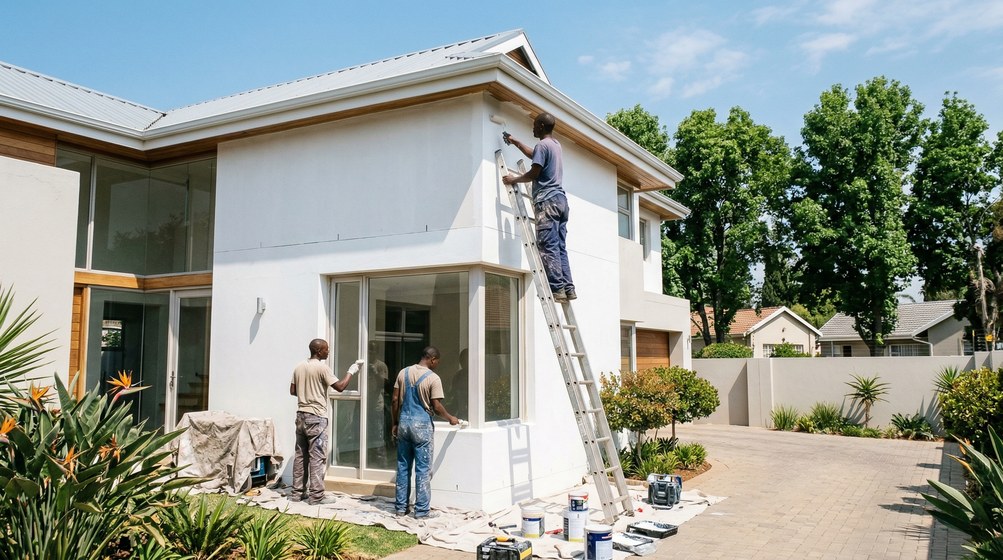
- Get a free quote from 5-Star reviewed Wapadrand painters
- Litres and coats stated up front so you can check the arithmetic yourself
- Empty tins left on site at handover — count them against the quote
How to Check You Got What You Paid For
Wapadrand sits high on the ridge with good-sized 1990s homes, and the exteriors here are large enough that the paint order itself is a meaningful part of the bill. That makes it one of the few places where a homeowner can independently verify a significant part of the job using nothing more complicated than arithmetic.
The two things most commonly short-delivered on any painting job are coats and product. Two coats quoted, one and a half applied. A premium product specified, a cheaper one substituted or the specified product thinned well past what the manufacturer allows. Both are close to invisible on a freshly finished wall and both show up two or three years early as thin, patchy, prematurely faded paint.
You cannot see film thickness. You can count tins. The rest of this page explains how the numbers should work so you can check them.
Guide Prices for Painting in Wapadrand
| Job | Guide price | What it covers |
|---|---|---|
| Exterior, single-storey 3-bed | R31,000 – R54,000 | Whole house, walls and eaves |
| Exterior, double-storey | R58,000 – R105,000 | Includes access equipment |
| Exterior wall rate, exposed elevations | R85 – R145/m² | Higher build for ridge exposure |
| Exterior wall rate, sheltered elevations | R70 – R115/m² | Standard premium acrylic |
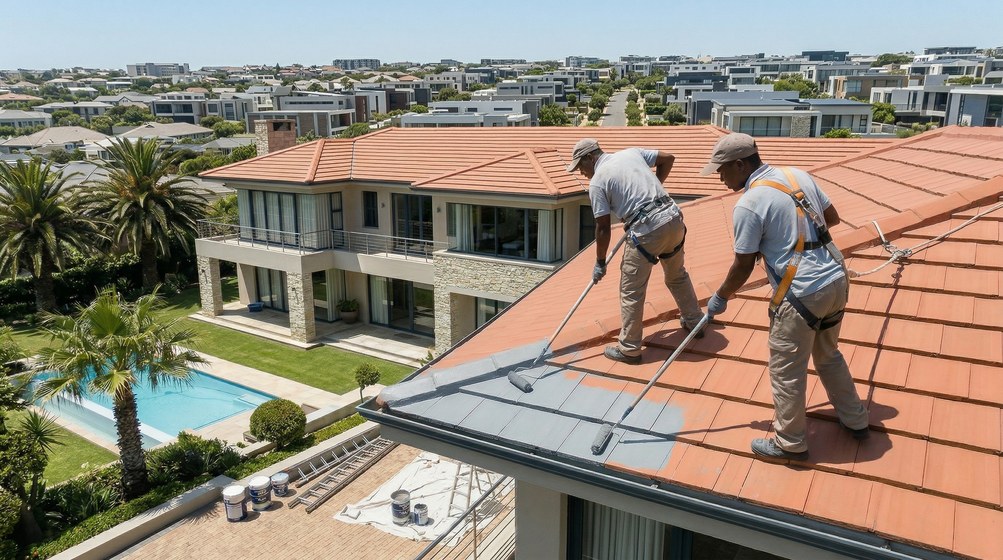
| Concrete tile roof | R95 – R155/m² | Wash, fungicide, two-coat acrylic |
| Interior, 4-bed | R26,000 – R44,000 | Walls, ceilings, prep and two coats |
| Boundary wall, both sides | R230 – R390 per metre | Per running metre |
| Trim, fascias and bargeboards | R120 – R240 per metre | Per running metre |
The Spreading Rate Arithmetic
Every paint has a stated spreading rate on the tin, expressed as square metres per litre for a single coat. For a typical exterior acrylic it is commonly somewhere around 6 to 8 m² per litre on a smooth, sealed, previously painted surface. Porous, rough or textured surfaces come in materially lower, and a first coat over bare or repaired plaster lower again.
The calculation is straightforward. Take your measured wall area, multiply by the number of coats, divide by the spreading rate. A 400m² exterior at two coats is 800m² of coverage. At 7m² per litre that is roughly 114 litres, so around six 20-litre tins. If four tins arrive on site for that job, either the area is wrong, the coats are not happening, or the product is being thinned.
Two honest qualifications. Real-world coverage is usually somewhat below the tin's figure, because the stated rate is measured under ideal conditions on an ideal surface. And a textured or heavily porous wall genuinely uses more. So expect the actual number of tins to be at or above your calculation, never well below it.
Thinning is where this gets abused. Most manufacturers permit a small percentage of water for the first coat on a porous surface and none at all for subsequent coats. Thinning beyond that stretches the product across more area, which is exactly what makes the tin count look fine while the film thickness is not. If a crew is adding significant water to topcoat tins, that is a problem.
What to Ask For and What to Check
- Ask for measured area, product name and litres on the quote. All three. With those you can do the arithmetic yourself before agreeing to anything
- Ask for empty tins to be left on site until handover. Count them. This one request changes behaviour more than any other, and a contractor who objects to it is telling you something
- Check the tins are what was specified. Product name and grade on the label, matching the quote. Substitution to a cheaper line within the same brand is common and hard to spot unless you look
- Look at the colour under the first coat. If you can see the old colour through the finished work, especially at edges and corners, the second coat either did not happen or went on far too thin
- Check edges, corners and behind downpipes. These are where a rushed job pulls thin. A well-covered open wall with starved edges tells you the crew was moving too fast
- Photograph the tint code and the product label at handover. It makes future touch-ups a match rather than a guess
Exposure Makes Film Thickness Matter More Here
Wapadrand's position on the ridge means the exteriors take strong high-altitude sun and a good deal of wind-driven rain in the storm months. Film thickness is what stands between the wall and that exposure, which is why the short-delivery problem matters more on a ridge property than it does on a sheltered stand lower down.
A wall that received one and a half coats instead of two will look identical to a properly coated one for about the first eighteen months. On an exposed elevation here the difference shows up around year three, as chalking, fading and a thin worn appearance on the sun faces, several years earlier than it should.
The dry windows are late March to May and mid-August to mid-October, and there is a coverage reason to stay inside them as well as a curing one. Wind speeds the surface drying of a coat so it skins before flowing out, and the natural response from a crew under time pressure is to spread the material further to keep up. Still, dry conditions produce both better adhesion and more honest coverage.
If you take one action from this page: ask for the litres on the quote and the empty tins at the end. It costs nothing and it is the most effective quality check available to a homeowner.
Painting Services We Cover in Wapadrand
- Exterior painting
- Roof painting
- Boundary wall painting
- Interior painting
- Colour consulting
- Plaster repairs
Wapadrand Painting Questions
Painting a home in Wapadrand? Contact Painters Pretoria East for a free, no-obligation quote from painters who work in this area every week.
painters Wapadrand, paint coverage Wapadrand, how many coats painting Pretoria East, house painting Wapadrand Pretoria, exterior painters Wapadrand, painting quotes Wapadrand
Get a Free Quote in Wapadrand →5-Star Reviews
Powered by leaderr