
- Get a free quote from 5-Star reviewed Menlo Park painters
- Steel window frames priced per window — the item that catches most Menlo Park owners out
- Old paint layers handled wet, not dry-sanded, on pre-1970s homes
Painting an Older Menlo Park Home
Menlo Park is older stock than most of Pretoria East, and that changes the job substantially. The typical home here is a single-storey build from the 1950s through the 1970s: solid brick, original plaster, steel window frames, timber doors, and in many cases a sequence of extensions added by successive owners over decades.
The walls are usually the easy part. What takes the time, and what drives the price, is everything that is not a wall — steel frames with rust bleeding through the enamel, timber doors that have been varnished over dirt too many times, ceilings that have been painted so often the detail has gone soft, and joins between the original house and a newer extension where the plaster and the movement do not match.
If a quote for a Menlo Park home is a single number with no line for windows and joinery, it is almost certainly excluding them or badly underestimating them.
Guide Prices for Painting in Menlo Park
| Job | Guide price | What it covers |
|---|---|---|
| Steel window frames, strip, anti-rust primer and enamel | R750 – R1,600 per window | Standard domestic frame |
| Steel window frames, rate per square metre | R220 – R390/m² | Measured over the frame area |
| Interior repaint, 3-bed older home | R22,000 – R36,000 | Walls, ceilings, prep and two coats |
| Interior walls only, no ceilings | R38 – R70/m² | Sound walls, two coats |
| Exterior walls, single storey | R28,000 – R48,000 | Wash, spot prime, two coats |
| New plaster on an extension | R85 – R135/m² | Plaster primer plus two coats |
| Timber door, strip and reseal | R900 – R2,200 each | Depends on condition and stripping required |
| Enamel on skirtings, trim and architraves | R95 – R180 per metre | Per running metre, prepared and coated |
Old Paint Layers: Handle Wet, Not Dry
This is the one genuinely important safety point on older Menlo Park homes and it gets ignored constantly. Paint manufactured before the mid-1970s could legally contain lead, particularly in enamels and in strong yellows, reds and greens. On a house of this vintage there is a real chance that somewhere under the current coat there is a lead-bearing layer, most likely on steel windows, doors, skirtings and burglar bars.
Dry-sanding or power-sanding that layer turns it into fine dust that settles across the room and the garden. The correct approach is straightforward and costs almost nothing extra: wet-sand, use a chemical stripper, or scrape with the surface damp, then collect and bag the residue rather than sweeping it. Keep children and pets out of the work area while trim is being prepared.
You do not need to test or panic. You do need a contractor who knows not to attack an eighty-year-old window frame with an orbital sander and no dust collection. Ask the question before work starts — the answer tells you a lot about who you are dealing with.
Enamel, Acrylic and What Goes Where
- Steel window frames: wire-brush or wet-scrape back to sound material, treat any rust with a rust converter or take it to bare metal, then a zinc phosphate or etch primer, then two coats of enamel. Skipping the primer on bare steel is why rust reappears within a year
- Water-based versus solvent enamel: water-based enamel is far pleasanter to live with, dries faster and does not yellow. Solvent-based still flows out harder and gives a tougher film on steel. On heavily used exterior frames solvent still has the edge; on interior doors and skirtings water-based is the sensible choice
- Timber doors and frames: if the finish is peeling and blotchy, strip it rather than adding another coat. Exterior timber wants a penetrating sealer system, not a surface varnish, because varnish on a north-facing door cracks and lifts
- Original plaster: older sand-cement plaster is more porous than modern render. Use a plaster primer, not a diluted topcoat, or the first coat sinks in unevenly and you end up needing three
- Extension joins: the crack where the old house meets a newer addition will move seasonally. Use a flexible acrylic sealant in the joint rather than rigid filler, and accept that it will need attention every few years
- Ceilings: on a home with many layers of old ceiling paint, expect to see flaking once you start. Budget for a scrape-and-prime rather than assuming a straight recoat
When to Paint a Menlo Park Home
Walls follow the standard Pretoria East pattern: late March to May first, mid-August to mid-October second. But if the bulk of your job is trim, windows and doors, the calendar shifts.
Enamel wants low humidity and reasonable warmth. The dry winter months on the Highveld give you the lowest humidity of the year, which is excellent for enamel flow and cure, provided the work is done in the middle of the day. Start after the frost has burned off, and finish enamel work by mid-afternoon so the film sets before the temperature drops. That gives you a usable window from roughly nine in the morning to three.
Interior work — ceilings, walls, skirtings, internal doors — can be done at any time of year. If you are staging a Menlo Park renovation, doing the interior in midsummer when exteriors are impossible is the efficient way to sequence it.
Painting Services We Cover in Menlo Park
- Interior painting
- Exterior painting
- Wood staining & sealing
- Anti-rust coatings
- Ceiling painting
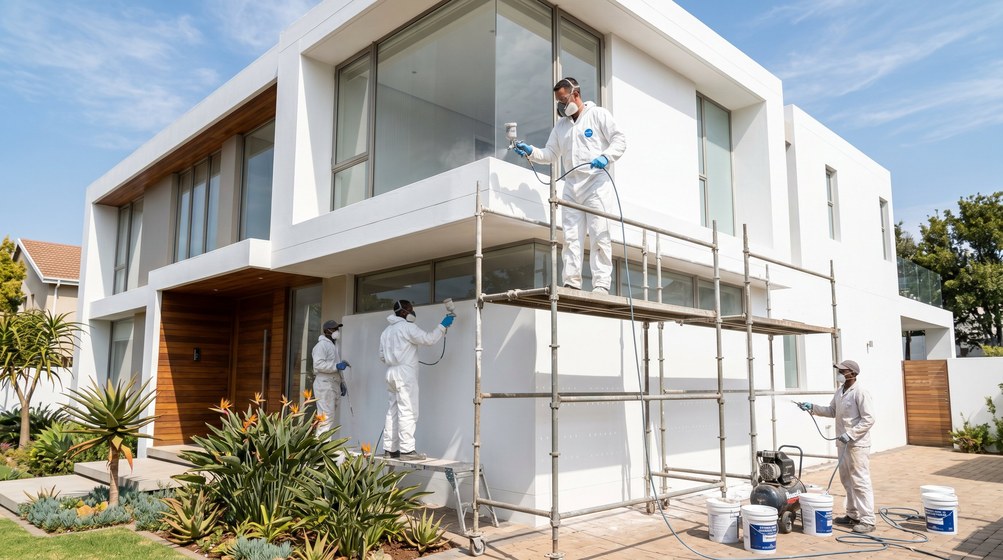
- Spray painting
Menlo Park Painting Questions
Painting a home in Menlo Park? Contact Painters Pretoria East for a free, no-obligation quote from painters who work in this area every week.
painters Menlo Park, steel window painting Menlo Park, house painting Menlo Park Pretoria, enamel painting Pretoria East, older home painting Menlo Park, painting quotes Menlo Park
Get a Free Quote in Menlo Park →5-Star Reviews
Powered by leaderr